A free guide book for every visitor to Lanzarote

I’ve blogged before about the free guide book that can be downloaded from the site lanzaroteguidebook.com.

Well, now the summer edition for 2008 has been released and it has got even bigger – now an incredible 112 pages of free information to help visitors prepare their visit to the island, or to help them find their way around whilst there.

The book contains information about the towns and resorts on the island with details of things to do and places to go, but it also has details of forthcoming events on the island and – for those who decide to make their stay more permanent – information on buying property.

If you’re heading to Lanzarote this summer then before you go out and buy expensive – and maybe even outdated – books about the island, download the guidebook and start planning!
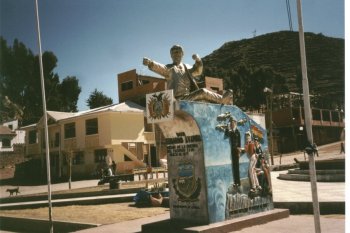

Bolivia, Chile and the (psst… Sea!)

It’s something that you never talk about as a visitor to Bolivia – well almost never: Bolivia’s access to the sea.  If you do, it stirs up hot feelings about at a topic that has been around for 125 years!

OK, here is the compact version of events:

– at the end of a war between Bolivia and Chile, Chile annexed land between Bolivia and the Pacific coast

– Bolivia was thus landlocked and it’s only access to a major port was by crossing the Andes and through Chile


A statue by Lake Titicaca commemorates the lost coastline

In fact, there is (or at least, was) a railway line that ran from La Paz down into Chile – the train running on it being an old S-Bahn carriage from Munich.

One of the easiest ways to think about the situation is to compare it with the connections between West Germany and West Berlin during the Cold War – they were there, but the West did not like being restricted by their neighbour and the East resented having to provide the access in the first place.

Chile allows Bolivia access to the sea, but on its terms.  Bolivia resents this, but does not really have much choice.

Take a look at the Bolivia coat of arms and you can count ten stars on it – one for each province in the country.  Except that Bolivia only has nine provinces – the tenth is the one that was annexed by Chile and remains on the coat of arms to show that Bolivia still makes a claim to this area.

So imagine my surprise this week when I read that Chile wants to give Bolivia better access to the port, such as being able to import goods without them being checked by Chilean customs.  I wonder how Bolivia will react?  More of a grateful “thank you” or will it be a case of “thanks, but we’ll like our land back and not just access to it”?

Swimming pools and Google Maps

When I was younger and living in the UK, I occasionally travelled to a nearby city by bus.  One of the highlights of the trip was, at least for me back then, being able to see of walls into peoples’ gardens from the top deck of the double-decker bus.

One of the more fascinating sights was in a small village, where one property had a swimming pool in their back garden.  Probably not many people even knew it was there, unless they were looking out of the window from the top deck at the right time.

I was reminded of those times when I read this article on the Telegraph website this week.  Apparently there is a new craze called “dipping” which involves finding such private swimming pools and organising impromptu -and illegal- pool parties in them.

This time, it is not a chance knowledge of a location obtained on a bus ride that is being used, but instead mapping sites such as Google Earth to find the pools and then social networking sites such as Facebook to organise the party.

I wonder why they do it?  After all, even if I know what is in someone’s garden I still have no right to enter the property and use it as if it was my own.  Is it a craze that will die down, or is it just the start of something much bigger with people using these resources for even worse means.

On the one hand I would hate to see such resources shut down – I use Google Maps a lot myself for route planning and the areal views can be very handy for seeing what sort of street I am driving to and what the chances are or finding somewhere to park nearby.

I would also hate to see more censorship and tracking on the internet, meaning that innocent people being monitored just because of an irresponsible few.

But at the same time I could understand it if there were calls for more to be done to stop such gatherings taking place.  It’s just that, how do you recognise someone organising an illegal “dipping” party and differ from someone holding their own pool party in their own swimming pool?

I think the owners of the property that I used to ride past have not got too much to worry about.  I just looked at the areal photo of the village and the pool looks as if it has been filled in and is now a lawn.

Please click on ACCEPT to give us permission to set cookies [more information]

This website uses cookies to give you the best browsing experience possible. Cookies are small text files that are stored by the web browser on your computer. Most of the cookies that we use are so-called “Session cookies”. These are automatically deleted after your visit. The cookies do not damage your computer system or contain viruses. Please read our privacy information page for more details or to revoke permission.

Close