Riots in Sucre

There were riots in Sucre last weekend with reports suggesting that at least 3 people were killed.

The UK Foreign Office had warned of disturbances, but demonstrations can easily occur in Bolivia. I’ve seen pictures of the riots in Sucre and these are on a different scale – especially when you hear that there have been fatalities.

Correo del Sur even shows pictures of riot police and tear gas today. So what’s it all about?

Well, when President Evo Morales was elected, he promised to reform the constitution to give more rights to indigenous people. As it happens, the draft of the new constitution has two points that are causing unrest in the country, and neither have anything to do with his election promise.

The first I have already written about – moving the seat of Government back to Sucre. This would make Sucre the sole capital of Bolivia.

The second, and this is what appears to have caused the riots, is that President Morales could be indefinitely re-elected.

After introducing a lot of reforms, such as reducing the President’s pay, on first glance this does look like it is going in a new direction. Even if there are other countries where the President can be re-elected as often as they care to stand for office, other limit this and whilst there is probably something to be said for both systems, I am suspicious of someone who wants to change the law in this way for their own benefit.

Bolivia has seen enough dictators in it’s past who clung on to power (only to be promptly displaced by a new regime). Even if this law is on a democratic basis, it doesn’t seem to be sending the right message to the people!

What effects a fuel crisis can have

Bolivian truckers and farmers are facing problems with their businesses as a result of fuel reforms, according to this article on the BBC News website, and they are blaming President Evo Morales and his reforms.

They say that the reforms, which included nationalising refineries last year, have cause shortages at the pumps. Hence a trucker cannot get enough diesel for one day’s work and farmers cannot get enough to run their machines.

One theory is that the fuel is so cheap, that it is being smuggled our of the country. The report claims that armed border guards are not trying to prevent this, whilst fuel is having to be imported from Venezuela to meet demands (or not, as the case my be).

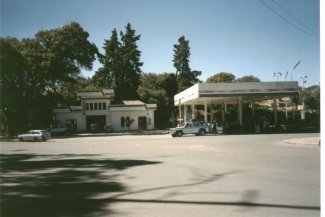
A petrol station in Sucre, July 2000
A petrol station in Sucre – without the queues – in July 2000

In the past, Bolivia has benefited from pipelines exporting resources such as gas to other countries in South America.

What has gone so terribly wrong, that it is now unable to provide enough fuel for it’s own people? The knock-on effects are simple – if a farmer cannot harvest his crops and a trucker cannot deliver the produce then it is only a matter of time before there are shortages throughout the country in the shops and markets. At that point it will be traders and consumers who also start to suffer…

A diplomatic mistake?

Yahoo! reported yesterday that the U.S. ambassador to Bolivia is to be asked to explain why he was photographed next to a convicted criminal. He already made himself unpopular by criticising one of Evo Morales’ quips about moving the U.N. away from New York.

Of course, the ambassador represents his or her own country in an official capacity. Normally it is inappropriate for such people to criticise a country’s leader.

The photo is interesting because it also features Gabriel Dabdoub, a businessman who opposes President Morales. Is it really the criminal on the photo who’s the problem?

I guess for the U.S. media, standing next to a criminal from Colombia is actually more of a scoop than a businessman would be.  But since the criminal is now behind bars, perhaps the Bolivian Government is getting a bit worried about who the U.S. ambassador is socialising with?

Please click on ACCEPT to give us permission to set cookies [more information]

This website uses cookies to give you the best browsing experience possible. Cookies are small text files that are stored by the web browser on your computer. Most of the cookies that we use are so-called “Session cookies”. These are automatically deleted after your visit. The cookies do not damage your computer system or contain viruses. Please read our privacy information page for more details or to revoke permission.

Close