Weihnachtsmärkte in England

In England wird ja kräftig geschmückt und dekoriert zu Weihnachten und auch sonst gibt es viele Traditionen, aber gibt es auch Weihnachtsmärkte in England?

Die Geschichte des Weihnachtsmarktes  auf der Insel ist nicht sehr lange. Nur seit einigen Jahren gibt es in einzelnen Städten einen Weihnachtsmarkt. Diese sind auch sehr angelehnt an die deutschen Märkte, denn es gibt deutsche Bratwürste, Glühwein, Schokoladennikoläuse, Christstollen und viele andere weihnachtliche Leckereien. So heißt auch der diesjährige Weihnachtsmarkt in Birmingham “Frankfurt Christmas Market 2009”. Ihn gibt es seit 1997, er zählt  ca. 80 Stände und gilt als der größte in England. Im Laufe der folgenden Jahre kamen noch weitere Weihnachtsmärkte hinzu, zum Beispiel in Bristol (1998),  Manchester (1999) oder im schottischen Edinburgh (2000).

Neben den deutschen Köstlichkeiten werden aber auch selbst hergestellte Dekorationsartikel verkauft. Wie es auf dem Weihnachtsmarkt in Birmingham aussieht können Sie hier sehen.

Ich selbst war noch nicht auf einem “englischen” Weihnachtsmarkt, denn Birmingham ist doch ein gutes Stück vom Heimatort meiner Schwiegereltern entfernt. Und in der Nähe gibt es noch keinen. Aber wer weiß vielleicht ändert sich das ja noch.

Seit einiger Zeit gibt es auch für britische Weihnachtsmarktfans Wochenendangebote für Flug- und Busreisen zu deutschen Weihnachtsmärkten, die auch gut ankommen.
The night the Wall came down

Today is a big day in Germany.   20 years ago today the East German government made the announcement that their citizens would be able to pass freely into the West. As one of the journalists asked from when this would apply, Günter Schabowski of the SED answered “as far as I am aware […] immediately”.

And so a large number of East Germans made their way to the border, leading to the now famous scene of the crowd pushing up the barrier at Checkpoint Charlie and flowing into West Berlin.

Much of the blogosphere is buzzing about this today, as are the mainstream media. And one of the biggest questions being asked is “where were you on that day?”

So where was I?

Well, at the time I was still living at home and studying for my A-levels. I remember waking up the next morning and watching the reports from Berlin during breakfast. I think at the time I may have realised that this was a significant event in German history, but maybe not quite the importance that it has come to have.

You see, I don’t think I knew that much about the GDR. I knew about the wall being built, and how Germany and Berlin were divided. I knew a little bit about the rules for visiting the East and how difficult it was to get to the West. But I could probably only name three towns in the East: Dresden, Weimar and Karl-Marx-Stadt (Chemnitz) and I cannot say that I knew much about things like the Stasi, or the internal politics and culture of the state.

One of my A-Level subjects was German, so inevitably the fall of the wall was going to be something that we talked about. I remember keeping files of newspaper cuttings about the events that followed, and in lessons we talked about the events that were changing Germany. We followed the first elections in March 1990, and the discussion about reunification in the same year.

However some wheels turn slower in A-Level education, and I do not remember these topics coming up much in the exams a year later.

They did have a larger impact on my time at university. With the GDR being one of the core components of studying German, much of this part of the course was probably re-written for my first year there. Many other components had to take a new direction as well, as current affairs in the country inevitably looked towards the East.

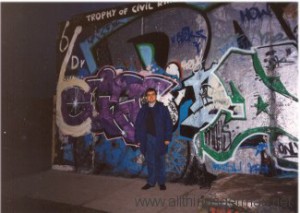
In front of the Berlin Wall in November 1996

In front of the Berlin Wall in November 1996

I never made it to the GDR myself. My first visit to that part of the country was in November 1990 when I spent a day in Erfurt. Not much had changed in the few weeks since reunification. The buildings were still drab and there were still Russian troops on the streets. Some of the roads were in bad way. In a way, I had a taste of the country without ever visiting it.

Strangely, I have never been back. With the exception of a few visits to Berlin, one of which I returned by car from, which entailed travelling through the Neue Bundesländer, I have never visited that part of Germany again, despite travelling extensively throughout the rest of the country either on business or with the Scouts. I don’t really know why, the opportunity just never arose.

¡Tenemos derechos! – Wir sind Rechthaber!

I have just spent the past three days in Frankfurt learning about a campaign that will be one of the focal points of the German Catholic Scouts (DPSG) in 2010.  The campaign is called ¡Tenemos derechos! which translates as “we have rights!”.

As is usual for the annual DPSG Jahresaktion, the whole thing that be split into two parts:

1. Raising Money

The easy part, you might say.  Not that raising money in itself is necessarily easy, but the goals are pretty much well defined.

There are 8 projects in Bolivia that require funding.  Each of these is in some way connected to children’s rights, 7 are in the different Bolivian regions (Distritos) and one is a national project.

I say that this is the easy part, because these are clearly defined projects and it is a matter of asking for donations, holding an event to raise money or even just selling some of the merchandising that will be available.

My previous experience with such events is that even if Groups do not want to get involved with the second part, they will at least contribute in some way to the fundraising part.

2. Politics

“Politics” may not be the best word to describe what I mean, but it sort of does the job.

The second half is more directly to do with children’s rights – both in Germany and in Bolivia.  Here the United Nations Convention on the Rights of the Child (UNCRC) plays a pivotal role as although Germany has signed and ratified the treaty, it places German asylum law above the requirements of the treaty.

This apparently makes it one of only two countries in Europe that take children into custody pending deportation.  We were also told that this can mean children of asylum seekers not being able to go to school as the right to schooling underlies the asylum process.

100_6135-bearbeitet-325

On the Bolivian side, children’s rights also play a role in the projects that will be funded, however here topics such as the right to education, cultural identity and participation play a stronger role.

Ideally the Groups in Germany will not only be raising money for the projects, but dealing with the political side at all levels in a way that is suitable for the different age groups.

To help them do this there is the annual Jahresaktionsheft – a booklet full of information and ideas for things to do, and a network of people to disseminate the information and assist where necessary.

Since I am now one of those myself, I will no doubt be blogging quite a bit more about this topic over the next 12 months.

Please click on ACCEPT to give us permission to set cookies [more information]

This website uses cookies to give you the best browsing experience possible. Cookies are small text files that are stored by the web browser on your computer. Most of the cookies that we use are so-called “Session cookies”. These are automatically deleted after your visit. The cookies do not damage your computer system or contain viruses. Please read our privacy information page for more details or to revoke permission.

Close
