School Holidays in Germany

The Schulferien (summer holidays) in Germany can be a complicated matter, as they are staggered throughout the summer. So whilst some of the Länder will have broken up for the holidays in the middle of June and are now getting ready for the new school year, others start their holidays in August and only return at the end of September.

To make sure that this system is fairly and evenly shared out amongst the German states, there is a formula governed by the Hamburger Abkommen, which means that different states are either early, late, or in the middle from year to year.

This system can make things complicated, if you are trying to organise a larger event and have children attending from more than one state. But luckily the dates are agreed several years in advance, and it is common to find them on calendars and in diaries.

However even if you do not have children at school, or are just visiting Germany, it is worth knowing when the holidays start and finish, as there are a few weekends when the motorways should be avoided. That is because the early states are on their way home whilst the later states are just starting at the same time.

This weekend, for example, the northern states Bremen & Niedersachen are travelling home, and the southern states of Baden-Württemburg and Bavaria are going away.

Making it the perfect weekend to avoid the north/south motorways.
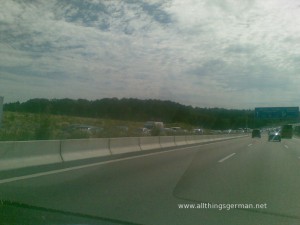
The A8 near Pforzheim - free-flowing eastbound, stau westbound
The A8 near Pforzheim - free-flowing eastbound, stau westbound

Introducing the “Schultüte”

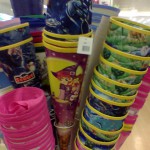
Schultüten

Schultüten

In preparation for our daughter starting school I have had to start looking into another German tradition.  Not only does she need her Schulranzen, but she will also expect a Schultüte on her first day.

Actually, I first came across the concept as a student in Germany in 1993 whilst watching a TV show called “Supergrips” (known elsewhere as “Blockbusters”) where the main prize was a Wundertüte – a sort of mystery prize.  At the time, I did not realise the significance of this item as part of German school life.

But be it a Schultüte or the infamous Wundertüte, it is the same shape: a large cone.

The Schultüte cone is colourfully decorated – often with the same sort of designs as the Schulranzen, and is purchased empty several weeks before school starts.

Into this cone then go small presents that the child receives on their first day.  These may be small books, or stationary, or even sweets.  The cones are certainly large enough to fit all three into them!

So given the possible contents, this cone can get quite heavy.  Which makes it even more amazing that the children carry it around with them on their first day at school – proud of what they have been given, but not even knowing what is inside.  You see, they don’t actually open the cone until they get home!

Our Schultüte is now awaiting its contents.  Any suggestions?

Buying the “Schulranzen”

Last weekend we went to buy a Schulranzen, an essential part of starting school in Germany.

I’ve been trying to find a good translation for Schulranzen over the past few days, and every time I keep coming back to “satchel”.  Although they look nothing like what I associate with that term, LEO agrees with me, and Wikipedia informs me that many years ago the term really was used for a traditional type of school satchel.  So satchel it is.

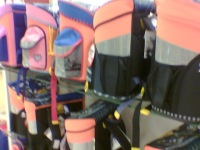
Schulranzen

Schulranzen

Not that they look anything like that.  Schulranzen refers to a type of rucksack that primary school children use.  It is one of those “must have” items to start school with, and there is a wide range in quality and prices.  Although the latter tends to start at around 100EUR.

One of the major brands is “Scout”, which are not only amongst the most colourful, but for some reason have a high percentage of plastic to them.  I don’t mean to reinforce the corners, I mean whole sides!

Then there are a few models from well-known brands such as Samsonite and Jack Wolfskin, but there are a whole range of other manufacturers to choose from.

We were lucky enough to find a shop stocking a good selection, so we were able to find one that we as parents were happy with, whilst at the same time has a design that our daughter liked.

Things to be considered were not only the material, but also the weight, the type of rucksack straps, the comfort of the rear side and the size and number of the compartments.  Some even came with matching sports bags, pencil cases and even purses.

Of course, this would not be Germany if there was not a DIN standard for Schulranzen – and the magic number is DIN 58124.  This specifies what percentage of the visible area has to be a luminous colour and how much has to be reflective.

In the end we agreed on a model from DerDieDas which not only conformed to that DIN and came with lots of extras, it also weighs only 850g.  The decision process in the shop took about 90 minutes, and means that a major part of our school preparations have now been completed.

Please click on ACCEPT to give us permission to set cookies [more information]

This website uses cookies to give you the best browsing experience possible. Cookies are small text files that are stored by the web browser on your computer. Most of the cookies that we use are so-called “Session cookies”. These are automatically deleted after your visit. The cookies do not damage your computer system or contain viruses. Please read our privacy information page for more details or to revoke permission.

Close