Einschreiben

If you need proof that you have sent a letter by post, then you send it “per Einschreiben”. In return for paying an additional fee to the normal postage you receive a receipt as proof of posting and can choose between different methods of delivery.

These methods are: the postman documents that he or she put the letter in the recipient’s postbox (Einwurf), the letter is handed over to someone at the recipient’s address who then signs of it (Übergabe), the letter is handed over only to the recipient in person (Eigenhändig), the letter is handed over and is signed for on a postcard which is returned to the sender (Rückschein) – similar to Recorded Delivery in the United Kingdom.

The Einschreiben method is often used when proof of sending and receipt are very important, eg. when cancelling contracts.

To hear a simple explanation and a short discussion in German, listen to the podcast:

(Press the “play” button to listen to the podcast)

Download a transcript

Download the MP3 file | Subscribe to the podcast

Lidl in the news

When I went shopping on Saturday I was very interested to see if my local Lidl would have the Stern magazine that appeared this week. Not because I wanted to buy it (I did that in my local newsagents), but being the main topic in this week’s edition, I was not so sure that they would.

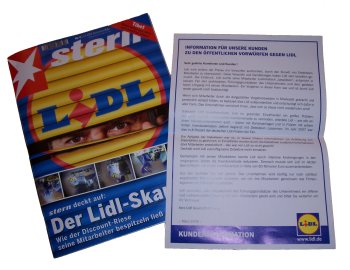
As it turned out, they did have it in stock – and behind the tills was a statement printed on Lidl headed paper to answer the claims made in the magazine.

lidl_stern.jpg
This week’s Stern and the statement from Lidl

Over the years I’ve some interesting (and sometimes unpleasant) reasons to get involved in employees’ rights. What Stern are claiming certainly beats almost everything I’ve experienced.

They report that detectives were installing miniature cameras in Lidl stores in Germany and then reporting back to the headquarters about what they had learnt. Actually, I find nothing wrong with cameras watching the tills as this could be for staff safety, but the problem I find is that the staff on the tills need to know that they are being filmed!

In this case, however, Stern reports that the detectives were not just interested in catching employees with their hand in the tills, but they were making notes about their private lives as well.

These were details such as:

– who could not go shopping until they received their wages
– how much did employees have left on their pre-paid mobile phones
– how store managers talked to their employees
– what employees did in their breaks

There are some things in the article that I can understand a detective being interested in, eg. who was working even though they were sick or on holiday; who avoided helping when there was heaving lifting to be done. But in my opinion these are things that the store manager should be dealing with. They don’t need a detective’s report to know these things.

As I said, Lidl has issued a statement about the article. They state that only 8% of their stores in Germany used such detectives last year. More importantly, they say that the detectives were meant to sort out thefts in these stores – last year Lidl lost 80 million Euros worth of stock! They did not want the detectives to make these additional notes about employees’ private lives.

They promise not to use detectives in future and to only use cameras that are clearly visible.

Problem solved? Well, maybe. This promise is certainly good news for the employees, but why did it have to go this far in the first place? Did it have to take a report by a national magazine to stop these practises?

A video of the riots in Sucre

A while ago I blogged about the disturbances in Sucre. Today I found a video on YouTube that was filmed while they were taking place.

It’s a strange feeling to see fights and smoke in streets that are familiar to me!

Content not available.
Please allow cookies by clicking Accept on the banner

Please click on ACCEPT to give us permission to set cookies [more information]

This website uses cookies to give you the best browsing experience possible. Cookies are small text files that are stored by the web browser on your computer. Most of the cookies that we use are so-called “Session cookies”. These are automatically deleted after your visit. The cookies do not damage your computer system or contain viruses. Please read our privacy information page for more details or to revoke permission.

Close