Evo Morales – Superstar?

La Cruces-Sun News reported today about an interview between Associated Press and Evo Morales regarding a new film portraying his life and how he became the president of Bolivia.

The article reports on how he was beaten by police on several occasions, once even being thrown out the back of a van.

It is probably experiences like this that has prompted him to call for all U.S. military personnel to leave Bolivia, as well as other foreign troops.

On the one hand there must be a certain amount of satisfaction to be in charge of the same people, who once treated him as a criminal, but is it not a bit early to make a feature film out of the story?

I thought that was something that was done after someone’s time as president. Or am I missing something here?

Internet cafés

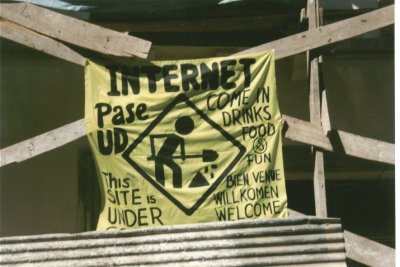
If you want to stay in touch with the rest of the world during a visit to Bolivia, you will inevitably find your way to an internet café. In Sucre there were several during my visit, and I also used one in La Paz. Although I am sure that there have been improvements since, there was a noticeable difference in the service quality between the different cafés.


A new internet café being built in Sucre, July 2000

Firstly, the connection in La Paz was much faster and more stable than in Sucre – I think the hardware was probably newer as well.

In Sucre, those cafés affiliated to the national telecommunications provider, Entelnet, definitely appeared to be faster.

La Paz was slightly more expensive, but all the cafés I visited offered good value for money – except one. A smaller, private internet café in Sucre (I think it was in the Calle Audencia) was so slow, that I was unable to read my webmail. As I left, I spotted a 56k modem at work and guess that the network was probably sharing this one analogue line.

As with any public computer, security is an important issue when using these facilities.  It is worth learning how to clear a web browser cache and cookies beforehand, as the computers may just be standard installations and not use any special software to reset them after one customer has finished as is common in European countries.

Child workers in Bolivia

Having reported on the abandoned children last week, it reminded me of the children that I saw in Bolivia working themselves to earn extra money for their families.

Before I went to Bolivia I was given the following advice: support the children that are earning their money honestly, as it motivates them to stay out of crime or begging.

It’s certainly true that having your shoes cleaned on a street corner will not really cost you much be German standards (more probably now than then). In Sucre I don’t remember so many children working in that business, that was something I encountered more in La Paz and Cochabamba. However, there were children working as guides at the cemetery.

For a small fee, they would show you around and point out the graves of important people. In fact, they had an extensive working knowledge of the layout and history of the cemetery.

In La Paz I did, once, have my shoes cleaned by a young boy. Actually they were my hike boots and needed it after the dust of Potosí! He worked so carefully – at one stage he picked up a tin of black shoe polish and I pointed out that my boots were brown. “No”, he replied, and pointed out that the bottom rim was indeed black and he proceeded to polish this from all sides with a thinner brush.

When he was finished my boots shone and I was prepared to pay more than the going rate, well a little bit at least to show my appreciation. Anything over the top and he might have taken offence to it.

Unfortunately he didn’t want to accept my dollar coin – he wanted a dollar bill, or the equivalent in Bolivianos. In fact, he preferred Bolivianos as was working as part of a group and had to divide up his earnings with the rest.

For me it was not easy to accept a child cleaning my shoes – it is the sort of thing that you would discourage in Germany, although many years ago in the UK it is the sort of thing the Scouts would have done in Job Week.

But by the time I was in La Paz, I had visited several institutions in the country and had learnt about some of the social structures. Often, these children are allowed to go to school for half a day in return for going out to work the other half. Either they earning their school fees, or a charity will pay the school fees in return for the parents accepting this form of deal.

If the children do not earn enough, the risk is that the parents will pull out of the deal and the children will no longer be allowed to go to school. Even worse, they may end up begging on the streets or even earning their money in less legal ways.

The child that cleaned my shoes and his friends seemed very cheerful – there were no adults with them putting pressure on them. They found their customers themselves and looked after them from beginning to end. Their earnings, although fairly shared out amongst the group, were not landing in the pocket of some overseer.

If your normal image of children working is of making clothes in illegal factories in Asia or even of boys sweeping chimneys in Victorian England – then this is no comparison.

Obviously it would be better for their education to be in school full time and not worrying about the family income, but as it is this is probably a reasonable compromise.

Please click on ACCEPT to give us permission to set cookies [more information]

This website uses cookies to give you the best browsing experience possible. Cookies are small text files that are stored by the web browser on your computer. Most of the cookies that we use are so-called “Session cookies”. These are automatically deleted after your visit. The cookies do not damage your computer system or contain viruses. Please read our privacy information page for more details or to revoke permission.

Close