Stuttgart 21

For the past few weeks, the German news has been full of reports about the “Stuttgart 21” project.

“Stuttgart 21” is the re-development of Stuttgart’s main station and the surrounding railway lines.  At present, Stuttgart is a “Kopfbahnhof”, meaning that it was built as a Terminus and the tracks end there.  Trains go in and out through the same entrance, consequently passengers in high-speed intercity trains change direction when the train stops there and train crews have to change ends to continue their journey.

It is not the only such station in Germany.  Frankfurt and Munich, for example, were built this way as well.

But now the station is to be transformed into a “Durchgangsbahnhof” – one where the tracks run through and out the other side.  This is said to save time, because the stops will be shorter – the train crews can stay where they are.

At the same time, new lines should improve connections to Paris and to Stuttgart’s airport. [Read more…]
Why the Germans are fussing about Street View

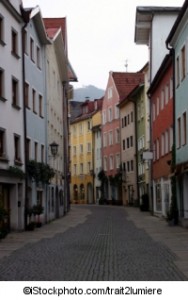
A street in Fuessen, Bavaria - ©iStockphoto.com/trait2lumiereFor several months, one topic has been in the news regularly in Germany: Google Street View.

This has several reasons, but to put it bluntly: Google didn’t ask permission.

Germany has some very strict privacy laws, many of which come as a result of the country’s recent history.  Those residents that lived through the period of the GDR are especially aware of people knowing too much about them.

There are, for example, rules on how photos of people can be used, and until a few years ago, you needed special permission to take an aerial photograph.

But whilst these situations are fairly clear cut and something that every photographer here needs to be aware of, taking a photograph of a building is different.

Many people take the opinion, that you need permission to photograph and then publish pictures of someone’s home.  On the other hand, I know of experts who say that this is not the case.  If taken from a public area, ie. the street, without any form of technical assistance, they say it is not a problem to take that photo and publish it. [Read more…]

The latest debate about summertime

You’d think that the new Government in Germany would have more serious problems to work on than whether or not to keep Daylight Saving Time.  The economy, for example.  It appears not.

A brief history:

Summertime (Sommerzeit) it its current form has only been around in Germany since 1980 – partly to catch up with its neighbours in the west who had introduced it during the 1970s to save energy.  Amazingly, both West and East Germany introduced it at the same time!

The dates for changing to and from summertime were not however the same as those used in the UK, leading to both countries having the same time during October each year, until the EU synchronised all Daylight Saving Time rules across its member states in 1996.

So for the past 13 years everything has been going fine, and all the countries of Western Europe change their clocks at the same time.

Which begs the question: why is one of the parties in the new German Government, the FDP to be precise, going to campaign for it to be abolished?

Of course, it would be ludicrous for Germany to abolish DST on its own, even if EU law allowed it to.  The country would become isolated time-wise in the summer months, something that happened to Switzerland for a single year in 1980.  This causes all sort of problems with time-critical things such as cross-border timetables.  But EU law forbids it to go this way anyway.

So instead they want to lobby the EU and its members to get the rule abolished instead.

Somehow I don’t think they stand much of a chance.

Please click on ACCEPT to give us permission to set cookies [more information]

This website uses cookies to give you the best browsing experience possible. Cookies are small text files that are stored by the web browser on your computer. Most of the cookies that we use are so-called “Session cookies”. These are automatically deleted after your visit. The cookies do not damage your computer system or contain viruses. Please read our privacy information page for more details or to revoke permission.

Close