Here’s a confusing sign of you’re a cyclist:
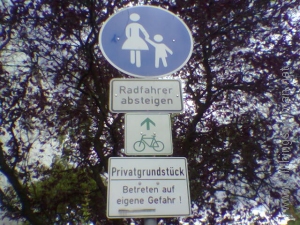
1. This is part of a marked out cycle route – recognisable by the green bicycle with the arrow.
2. But it’s for pedestrians only – see the white mother and child on a blue background.
3. So cyclists should dismount – “Radfahrer absteigen”
4. Oh, and it’s private property anyway – “Privatgrundstück”, but you can still push your bicycle across it at your own risk – “Betreten auf eigene Gefahr!”.
 Sam Alper eröffnete 1958 in Reading, Berkshire das erste Little Chef Restaurant. Es hatte elf Sitzplätze und bald ist eine Kette entstanden die in den 80er Jahren sehr florierte und vor allem bei Kaufleuten beliebt war. Auch heute noch erfreut sich Little Chef großer Beliebtheit und hat sich im Vereinigten Königreich weit ausgebreitet. Angeboten werden traditionelle englische Gerichte wie
  Del Boy und Rodney sind Brüder, ihre Eltern sind früh gestorben und so hat Del Boy in etwa die Vaterrolle übernommen. Im Erwachsenenleben der beiden etwas ungleichen Brüder, vor allem bei Del Boy geht es darum irgendwann Millionär zu werden. Ein Spruch von ihm ist: “Nächstes Jahr um diese Zeit sind wir Millionäre!”. Del Boy hat ein Geschäft “Trotters Independent Traders” das ein bisschen fragwürdig ist denn es ist nicht angemeldet und er verkauft wenig qualitative und dazu noch illegale Waren zum Beispiel Videokameras von der russischen Armee, leuchtend gelbe Farbe oder Sexpuppen die mit einem explosiven Gas gefüllt sind.