Today is a big day in Germany. 20 years ago today the East German government made the announcement that their citizens would be able to pass freely into the West. As one of the journalists asked from when this would apply, Günter Schabowski of the SED answered “as far as I am aware […] immediately”.
And so a large number of East Germans made their way to the border, leading to the now famous scene of the crowd pushing up the barrier at Checkpoint Charlie and flowing into West Berlin.
Much of the blogosphere is buzzing about this today, as are the mainstream media. And one of the biggest questions being asked is “where were you on that day?”
So where was I?
Well, at the time I was still living at home and studying for my A-levels. I remember waking up the next morning and watching the reports from Berlin during breakfast. I think at the time I may have realised that this was a significant event in German history, but maybe not quite the importance that it has come to have.
You see, I don’t think I knew that much about the GDR. I knew about the wall being built, and how Germany and Berlin were divided. I knew a little bit about the rules for visiting the East and how difficult it was to get to the West. But I could probably only name three towns in the East: Dresden, Weimar and Karl-Marx-Stadt (Chemnitz) and I cannot say that I knew much about things like the Stasi, or the internal politics and culture of the state.
One of my A-Level subjects was German, so inevitably the fall of the wall was going to be something that we talked about. I remember keeping files of newspaper cuttings about the events that followed, and in lessons we talked about the events that were changing Germany. We followed the first elections in March 1990, and the discussion about reunification in the same year.
However some wheels turn slower in A-Level education, and I do not remember these topics coming up much in the exams a year later.
They did have a larger impact on my time at university. With the GDR being one of the core components of studying German, much of this part of the course was probably re-written for my first year there. Many other components had to take a new direction as well, as current affairs in the country inevitably looked towards the East.
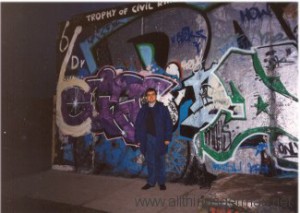
In front of the Berlin Wall in November 1996
I never made it to the GDR myself. My first visit to that part of the country was in November 1990 when I spent a day in Erfurt. Not much had changed in the few weeks since reunification. The buildings were still drab and there were still Russian troops on the streets. Some of the roads were in bad way. In a way, I had a taste of the country without ever visiting it.
Strangely, I have never been back. With the exception of a few visits to Berlin, one of which I returned by car from, which entailed travelling through the Neue Bundesländer, I have never visited that part of Germany again, despite travelling extensively throughout the rest of the country either on business or with the Scouts. I don’t really know why, the opportunity just never arose.

