Bolivian’s National Holiday

Yesterday (6th August) was Bolivia’s national holiday.  On this day, the President visits the constitutional capital – Sucre – and various organisations take part in a parade around the town square from where he traditionally waves to them from the balcony of one of the Government buildings.

Among those marching are the Scout Groups from Sucre, and 9 years ago I was lucky enough to take part in the parade with one of them.
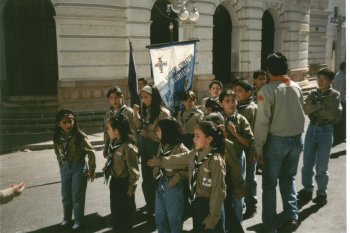
Grupo Sagrado Corazón, Sucre

Grupo Sagrado Corazón, Sucre (6th August, 2000)

This year the parade looks to have been slightly different.  The online newspaper La Razón has a report this morning containing a photo of the President himself walking around the square.  Was he leading the parade?  Is this a new idea?   Or did his predecessor do the same thing and I missed it because I was so far behind?

Walking at the head of the parade may well be a sign that he is leading the country with the people rather than from above them, and comes at a time when parts of the new constitution are coming into force.

The constitution not only allows President Morales to be re-elected in December, but is said to give more autonomy to indigenous communities.  This fact alone must create some difficult situations, as last year one region did try to hold a referendum on autonomy, only for this to be opposed by none other than Morales himself.

So is it one rule for indigenous communities, and another rule for the rest?  We will have to wait and see what difference the new constitution really does make.

Back to the national holiday, and I was hoping to see some photos of the event on the website of the local newspaper: Correo del Sur.  But for some reason, their website is down.  Not the best week for that to happen.  Anyone know why?

And whilst on the subject of photos, it is worth mentioning that at the end of the parade all of the Scout Groups get together for a District photo – something that takes some organising.  I am on the photo that was taken in the year 2000, and was promised a copy of it.  Unfortunately, I am still waiting for it.

Laguna Verde – the emerald lake

I have never been to the Laguna Verde in Bolivia, and when I first heard about it I imagined something similar to El Golfo on Lanzarote.

But I was wrong.  It may have a similar background, with minerals from nearby volcanoes being responsible for the colour, whereas El Golfo is easily accessible for tourists, the Laguna Verde is in a part of Bolivia that is scarcely populated, it is much larger, and it is over 4,000m above sea level.

To reach it you will probably want to first travel to Uyuni, and then take a tour of the salt flats from there.

Agreeing on borders

One of the most important events for anyone interested in 20th Century Bolivian history is the Chaco war, (1932-1935) fought between Bolivia and Paraguay over suspected oil resources in their border region.

As in many previous conflicts that Bolivia was involved in, it ended with the country losing land (approximately 75% of the Chaco region went to Paraguay).  In 1938 a truce was signed in Argentina, but this was not really the end of the subject as many Bolivians were not happy with the result.  It remained a topic as sensitive as the loss of the coastline to Chile.

Recently the topic has resurfaced, and Bolivia and Paraguay have signed an agreement to finalise the border – more than 70 years after the end of the conflict.

It could be compared to a similar situation between Germany and Poland.  Their common border was agreed in Potsdam in 1945 and is known as the “Oder-Neiße-Border“.  A formal agreement between the GDR and Poland was made in 1970, and to avoid any discussion on its validity it was confirmed in the 4+2 agreement on the re-unification of Germany in 1990.  A final contract between the states was signed in 1992.

On the other side of Bolivia, another border project is being discussed: a 150km tunnel to link Bolivia to the Pacific Ocean.  As much as I like the idea, it does sound like rather a big undertaking for those two countries.  And because of the area it is in, Peru would have to agree as well.

Please click on ACCEPT to give us permission to set cookies [more information]

This website uses cookies to give you the best browsing experience possible. Cookies are small text files that are stored by the web browser on your computer. Most of the cookies that we use are so-called “Session cookies”. These are automatically deleted after your visit. The cookies do not damage your computer system or contain viruses. Please read our privacy information page for more details or to revoke permission.

Close