I’m not sure if it’s just the summer heat, but it seems to me that people’s attention for simple rules of the road has gone out of the window lately.
It all started with the bicycles. We’ve noticed this year a lack of respect on the part of cyclists for red lights.
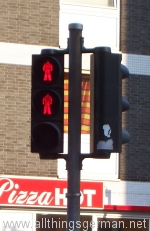 It doesn’t matter what kind of red light: pedestrian crossings, crossroads, or even cycle paths. They just ride straight through them. It’s a common occurance on the Hohemarkstraße in Oberursel, where I see at least one cyclist every week go through at red light – usually whilst pedestrians are crossing.
But at crossings it can be even worst – they veer off to the right to use the pedestrian crossing across the side road and avoid the red traffic light that way. Of course, the pedestrian crossing may also be at red, but that doesn’t seem to worry them.
Then there are the pedestrians who just walk across the main road without looking, forcing drivers to brake hard. And I don’t mean taking a run at it, I mean leisurely walking across.
At one point on the Hohemarkstraße there they do it about 50m from the nearest pedestrian crossing, which has usually just gone back to green for motorists before they cross.
Others do take the trouble to walk to a pedestrian crossing, only to use it when it’s set to red anyway.
At this point I don’t want to forget to mention the cyclists who ride on the right-hand side of the road, and then turn left across the traffic without looking, or those that ride on the wrong side of the road, or ride the wrong way down a one way street (which is allowed in certain parts of Frankfurt) and then shoot out at the end without stopping, regardless of the fact that drivers will not be expecting anything to come out that way.
Not that some drivers are any better. I recently stopped at an unguarded railway crossing because I could see that a tram was coming, and trams have priority over cars (they are also bigger, heavier, take longer to stop, and can do a lot of damage if you get in their way). The driver behind me started waving madly at me for stopping, she then got impatient and tried to drive around me and get across the crossing before the tram came.
The tram won.
But it turns out that this is even worse in other parts of Germany. On a recent trip to Cologne I was able to observe how cyclists and pedestrians use the same path along the Rhine. The cyclists swerve between the pedestrians at quite a speed, or just ring their bells and make them get out of the way. Marking out separate paths might be a good idea.
Worse still, where there are dedicated cycle paths there are often pedestrian crossings. I watched, as the lights on the cycle path and the main road turned to red, and the pedestrian lights turned to green. The pedestrians started to cross, and the cyclists didn’t care.
They rang their bells anyway, ignored the red lights, and made the pedestrians get out of their way.
 1. Sie haben sehr viele Bücher. Selbst Bücher, die man sonst nirgendwo findet. In einer Zeit bevor man Online Bücher bestellte, war es der Laden um seltene Bücher zu kaufen. Zwar konnte man in einem kleinen Buchladen in vielen Städten Bücher bestellen, aber wer stöbern wollte fuhr nach London zu Foyles.