New in 2009: how to get married in Germany

Almost every student of German will know that you cannot get married in a church in Germany without going to the registry office to get married there first.  This either results in the weddings being on the same day, consecutive days, or even months apart.

This is all down to a little known law called the “Reichsgesetz über die Beurkundung des Personenstands und die Eheschließung” which was passed in 1875 and is currently included in the “Personenstandsgesetz”.

That law took away the power of the churches to legally marry people, and instead passed this on to the state.  This law is about to change.

The “Personenstandsrechtsreformgesetz” makes a number of changes to the way in which the Standesämter – who register births, marriages and deaths in Germany – work.  The most significant change means that it will be possible to get married in a church, legally, without having to go to the registry office first.

The protestant Church in Germany has, however, announced that it is not planning any changes and will still only carry out weddings after the civil ceremony.

Two more Christmas markets

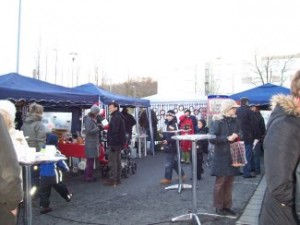
Christmas market at the book shop...

Christmas market at the book shop…

To finish off our series of visiting Christmas markets in the area, we went to two smaller ones.

The first one was in front of our local supermarket and organised by the book shop there.  There were stands selling waffles, mulled wine, crêpes, and of course books.  But there were also stands from local organisations such as our Kindergarten selling home-made decorations and biscuits.

A local Nikolaus appeared at one point and took the children into the shop for a story.

... and at the animals' home

… and at the animals’ home

Our second visit was to the local Tierheim (animal home).  This was a good chance to see inside the home, and although the market itself was somewhat spread out and not that big, we did partake of coffee and mulled wine, as well as buying a Christmas pyramid at the flea market.

To find out more, listen to the podcast:

(Press the “play” button to listen to the podcast)

Download the MP3 file | Subscribe to the podcast

Pendlerpauschale: or a taxing drive to work

Thousands of German employees breathed a sigh of relief a few days ago – the cancelling of the so-called Pendlerpauschale was ruled to be invalid by Germany’s constitutional court.

Germans pay a lot of tax compared to may other European countries, but they also have a lot more ways to claim tax back than in those other countries as well.  The rules are very complex, but generally speaking it is possible to offset such things as courses and books that you have paid for privately, as long as they are for your career.

Until the end of 2006, the cost of getting to work could also be claimed back, either by producing tickets for public transport or on the basis of the kilometers driven.  But then, all that changed, and the first 20km could no longer be claimed back.

For the past two years, people have been arguing that this is unfair and several local courts had already dealt with the issue.  But now, the consitutional court has taken the final, binding decision.

It didn’t take long for the politicians to respond.  On the lunch-time news that very same day there was an interview in which they were saying that they did not like the verdict, but that they would – as soon as possible – repay all of those affected since Januar 2007.

I checked my tax statement for that year, and sure enough it contained the important words (translated) “The tax statement is not yet conclusive.  Should a court decide that dropping the Entfernungspauschale be unlawful, it will be revised.  You do not need to contact us for this”

Let’s see how long they take…

Please click on ACCEPT to give us permission to set cookies [more information]

This website uses cookies to give you the best browsing experience possible. Cookies are small text files that are stored by the web browser on your computer. Most of the cookies that we use are so-called “Session cookies”. These are automatically deleted after your visit. The cookies do not damage your computer system or contain viruses. Please read our privacy information page for more details or to revoke permission.

Close
