Martinstag

The 11th November is known as Martinstag or Sankt Martin. Originally the start of a 40-day period of fasting before Christmas, it is now more associated with the processions of children holding lanterns that take place after dark. Many families eat goose on this day.

The day also sees the start of the Karneval season.

To hear a simple explanation, a short discussion, and a children’s song in German, listen to the podcast:

(Press the “play” button to listen to the podcast)

Laterne, Laterne,
Sonne, Mond und Sterne,
brenne auf mein Licht,
aber nur meine liebe Laterne nicht.

Download a transcript

Download the MP3 file | Subscribe to the podcast

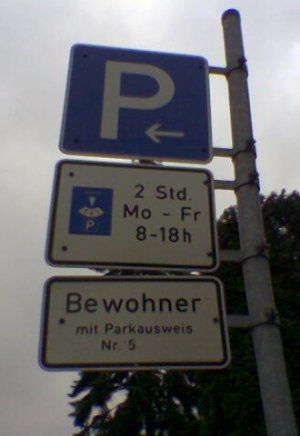
How long can I park here for?

This sign really puzzles me:

schild_bewohner.jpg

Mondays to Fridays I can park for 2 hours between 8am and 6pm using a Parkscheibe, or if I am a local resident with Parkausweis Nr.5. But what happens after 6pm?

Can I park here as a non-resident then? Or is it residents only? Or unlimited time?

I asked some people local to the town where I saw the sign (and wanted to park), but no-one really seemed to be too sure. I have also heard that traffic warden have checked the cars after 6pm, so perhaps it really is just for residents? Anyone know for sure?

Why it pays to speak Spanish

If you go into a shop in Europe, then the prices of the items on sale are usually on display. They are fixed an non-negotiable.

If you take a taxi in Europe, then the price is shown on the meter. It depends on the distance travelled and maybe the time of day.

In Bolivia, things work a bit differently. For a start, taxi fares are agreed in advance, and are normally a fixed price for anywhere within the local town, but per person. It is, however, possible to arrange a discount when travelling in a group and you fill the taxi up.

Then there are the shops and the markets – you can bargain with the vendors and arrange a lower price if, for example, you want to buy more than one item.

This obviously takes some getting used to, and is made easier if you can speak Spanish well enough. If you don’t, then your efforts will be less successful.

It is a fact of life in Bolivia, that tourists who speak Spanish (or at least attempt to) get a better deal when buying products and services.

But there is another factor in the buying equation that should not be ignored – being accompanied by a Bolivian. This can often knock the price down a little more.

And if know exactly what you want and can get a Bolivian friend to go into the shop on their own and buy it for you, you may even save an extra Boliviano on top.

I remember that a taxi ride in Sucre used to cost 3 Bolivianos per person, regardless of distance. For 3 people I could knock the price down to 7Bs, if one person was a Bolivian, they might even get it down to 6Bs.

In Cochabamba our Bolivian friends even stopped the taxis to ask them to take us for 1Bs/person. There were so many taxis in the queue (and we were 24 people in the group) that if a driver wouldn’t agree to the price, then they would just ask the next one. It worked!

So it really does pay to speak Spanish!

Please click on ACCEPT to give us permission to set cookies [more information]

This website uses cookies to give you the best browsing experience possible. Cookies are small text files that are stored by the web browser on your computer. Most of the cookies that we use are so-called “Session cookies”. These are automatically deleted after your visit. The cookies do not damage your computer system or contain viruses. Please read our privacy information page for more details or to revoke permission.

Close
