When translations go wrong: Lanzarotean

One of the problems with international translations is that you have to deal with words connected to places that don’t always have an obvious translation in every language. One example I had a few years ago was “Hong Kong Chinese” – I rang the German Embassy in London to ask them for advice!

So what is something that comes from Lanzarote? Most English texts use “Lanzarotean” and the German equivalent would seem to be “Lanzarotisch”. One restaurant didn’t agree and used “Lanzarotenisch” which maybe sounds more exotic?

Lanzarotean

Internet cafés

If you want to stay in touch with the rest of the world during a visit to Bolivia, you will inevitably find your way to an internet café. In Sucre there were several during my visit, and I also used one in La Paz. Although I am sure that there have been improvements since, there was a noticeable difference in the service quality between the different cafés.


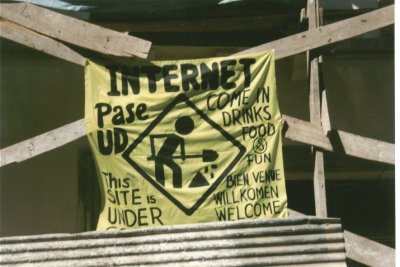
A new internet café being built in Sucre, July 2000

Firstly, the connection in La Paz was much faster and more stable than in Sucre – I think the hardware was probably newer as well.

In Sucre, those cafés affiliated to the national telecommunications provider, Entelnet, definitely appeared to be faster.

La Paz was slightly more expensive, but all the cafés I visited offered good value for money – except one. A smaller, private internet café in Sucre (I think it was in the Calle Audencia) was so slow, that I was unable to read my webmail. As I left, I spotted a 56k modem at work and guess that the network was probably sharing this one analogue line.

As with any public computer, security is an important issue when using these facilities.  It is worth learning how to clear a web browser cache and cookies beforehand, as the computers may just be standard installations and not use any special software to reset them after one customer has finished as is common in European countries.

Bingen to Assmannshausen

This is the second part of my series about my weekend walking between Rüdesheim and Oberwesel. Part one can be read here.

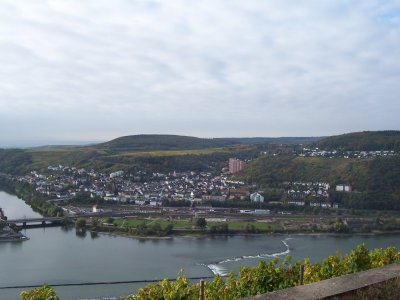
Leaving the Niederwalddenkmal behind us we continued to walk across the Rüdesheimer Berg, a group of vineyards on the slopes overlooking the Rhine. On the opposite bank lay Bingen, its many railway lines clearly visible.

bingen.jpg
Bingen

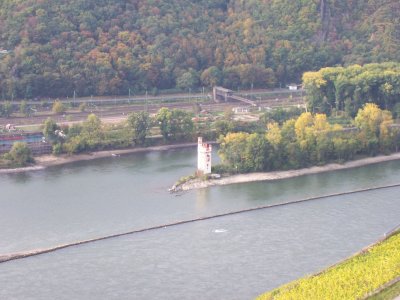
The next sight to see was the Mäuseturm, built on a island in the middle of the Rhine. The tower that currently occupies the site was built in the 19th Century as a Prussian signal tower, before that there was a customs tower on the island.

The name of the tower comes from a legend about the Bishop of Mainz in the 10th Century, who was apparently besieged and later eaten by a swarm of mice in revenge for not distributing grain to his people during a time of famine.

maeuseturm.jpg
The Mäuseturm, seen from the Rüdesheim bank of the Rhine

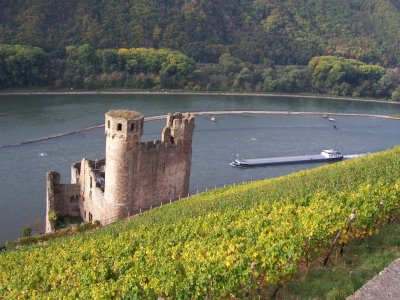
Opposite the Mäuseturm lie the remains of Burg Ehrenfels. The castle was also used in the collection of tolls but was severely damaged in the 17th Century. Later parts of it were removed when the vineyards were being planted.

burg_ehrenfels.jpg
Burg Ehrenfels

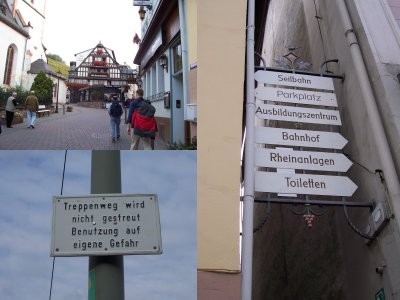
Our route led us directly behind the castle and continued towards Assmannshausen. Here we had the choice of taking the chairlift or going down a flight of steps into the town – the steps going almost through peoples’ back gardens and coming out in an alleyway in the middle of the town.

Bingen to Assmannshausen
Assmannshausen viewed from the vineyard path

assmannshausen2.jpg
Assmannshausen

Tickets for the chair lift can be combined with those for the cable car in Rüdesheim, so it is possible to do a round trip, returning from Assmannshausen to Rüdesheim by boat.

For our journey, however, we continued through the town and followed the path back up the hill towards Lorch…

Please click on ACCEPT to give us permission to set cookies [more information]

This website uses cookies to give you the best browsing experience possible. Cookies are small text files that are stored by the web browser on your computer. Most of the cookies that we use are so-called “Session cookies”. These are automatically deleted after your visit. The cookies do not damage your computer system or contain viruses. Please read our privacy information page for more details or to revoke permission.

Close